
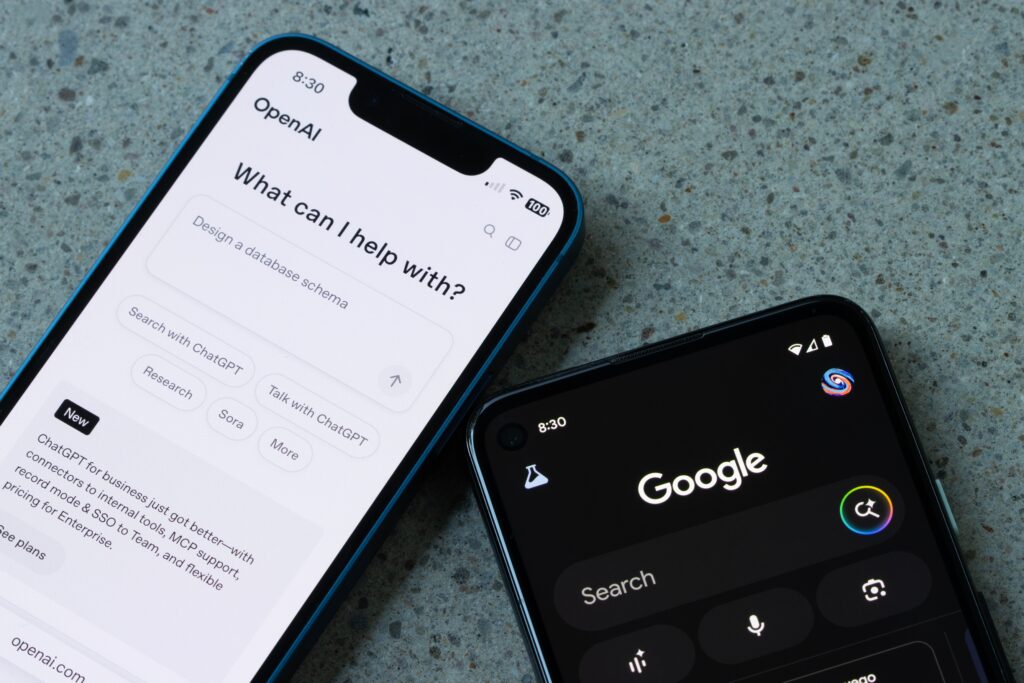
The way we look for information online has completely changed. Just a few short years ago, typing a few keywords into a search bar and scrolling through blue links was the only way to find answers. Now, users can have full conversations with search engines, ask complex follow-up questions, and get synthesized answers instantly.
This shift leaves many business owners and marketers wondering about the future of their website traffic. The battle between standard Google search and new AI search tools changes the rules of optimization. You need to understand how these different systems work to keep your content visible.
We will break down exactly how standard search compares to AI-driven search tools. You will learn the main differences in how they process information and discover practical steps to adapt your strategy for both platforms.
We will break down exactly how standard search compares to AI-driven search tools. You will learn the main differences in how they process information and discover practical steps to adapt your strategy for both platforms.
The State of Search Right Now
Search engines have evolved rapidly, creating two distinct ways people interact with the internet. Understanding the mechanics of both systems is crucial for getting your content seen by the right audience.
Standard Google Search Explained
Traditional Google search relies on indexing and ranking web pages based on relevance and authority. When you type a query, the search engine crawls its massive database to find pages that match your keywords. It then uses hundreds of ranking factors, like backlinks and site speed, to determine which pages deserve the top spots.
This model requires the user to do the heavy lifting. You type a query, scan the results, click a link, and read the page to find your specific answer. If the first page does not help, you go back, refine your keywords, and try again. It is a transactional process built on keyword matching and popularity metrics.
For content creators, optimizing for this system means focusing on specific keywords, building authoritative links, and creating comprehensive articles. You want to prove to the algorithm that your page is the most relevant resource for a specific term.
The Rise of AI Search Engines
Current AI search tools like ChatGPT, Perplexity, and Claude take a completely different approach. Instead of handing you a list of links to sort through, they read the top results for you. They synthesize the information and generate a direct, conversational answer to your prompt.
These tools understand context and nuance. You can ask a complex, multi-part question, and the AI will pull data from several different sources to build a complete response. If you need clarification, you simply ask a follow-up question naturally, just like you would when talking to a friend.
This conversational model shifts the focus from finding pages to finding answers. Users save time because they no longer have to click through multiple websites to piece together information. For businesses, this means your content must be clear, authoritative, and easily digestible by AI language models if you want to be cited as a source.
Key Differences Between AI Search and Google
To adapt your content strategy effectively, you need to understand the core differences between how these two systems operate. They cater to different user needs and require different optimization tactics.
Conversational vs Transactional Searching
Standard search engines are highly transactional. A user inputs a specific phrase like “best running shoes 2026,” and Google provides a list of product roundups and store pages. The interaction ends once the user clicks a link.
AI search tools thrive on conversation. A user might say, “I am training for a marathon on flat terrain and have wide feet, what running shoes should I buy?” The AI processes all those variables and gives a personalized recommendation. The interaction continues as the user asks follow-up questions about sizing or durability.
Your content needs to anticipate these specific, nuanced questions. Broad overviews are less helpful to AI models than deep, specific answers to complex problems.
Direct Answers vs Blue Links
Google is famous for the “ten blue links” on the first page. While features like featured snippets have changed this slightly, the core goal is still to drive traffic directly to websites. Standard SEO focuses on getting users to click your link.
AI search provides the answer directly in the chat interface. Tools like Perplexity will cite their sources with small footnotes, but the user does not always need to click through to get the information they need. This zero-click environment means you have to rethink how you measure success.
Instead of just tracking raw traffic, you need to focus on brand visibility and authority. Being cited by an AI tool positions you as a trusted expert, even if the user does not immediately visit your site.
Intent Decoding
Traditional search engines sometimes struggle with intent. If you search for “apple,” Google has to figure out if you want the fruit or the tech company based on your past search history and location.
AI search tools excel at understanding intent because users provide more context in their prompts. The AI reads between the lines and understands the relationship between concepts. This means you do not need to stuff exact-match keywords into your text. Instead, you need to write naturally about related concepts and cover a topic comprehensively.
What This Means for Your Content Strategy
You do not need to abandon everything you know about standard search optimization. The foundational elements of good content still apply. However, you do need to adjust your approach to ensure AI tools can find and understand your work.
Focus on Deep Human Value
AI can generate generic content in seconds. To stand out, your content must offer something AI cannot replicate on its own: unique human experience. Share your firsthand expertise, personal anecdotes, and original data.
When you provide a unique perspective or share the results of your own experiments, AI tools are more likely to reference your work. They look for authoritative sources to back up their claims. Make sure your content is the source they want to cite.
Optimize for the Conversation
Stop thinking about isolated keywords and start thinking about natural language questions. Structure your content to directly answer the questions your target audience is asking.
Use clear, descriptive headings. Break your text into scannable paragraphs. Use bullet points and numbered lists to make your information easy for both humans and AI bots to parse. The clearer your structure, the easier it is for an AI tool to extract your insights and serve them to users.
Prioritize Brand Authority
Since AI search tools compile information from across the web, building a strong brand reputation is more important than ever. If your brand is consistently mentioned alongside specific topics on other reputable websites, AI models will associate you with that expertise.
Focus on digital PR, guest posting, and building relationships within your industry. When other trusted voices talk about your brand, it sends a strong signal to AI search engines that your content is reliable and worth referencing.
The Future is Hybrid
We are not looking at a future where AI completely replaces standard search engines. Instead, we are entering a hybrid era. Google is already integrating AI overviews into its standard search results, blending the two approaches.
Users will likely use standard search for quick, transactional queries like finding a local restaurant or navigating to a specific website. They will turn to AI search for research, brainstorming, and complex problem-solving.
Your job is to show up in both places. You achieve this by creating high-quality, deeply informative content that answers real user questions. You must balance the technical requirements of standard algorithms with the conversational needs of AI models.
Next Steps for Your Content
Adapting to this new search environment starts with a content audit. Review your existing pages to see if they answer specific questions clearly. Update older posts with fresh, original insights that go beyond generic advice.
Focus on building topical authority rather than chasing individual keywords. Create clusters of content that thoroughly explore every angle of a specific subject. By establishing your website as a comprehensive resource, you ensure that both standard search engines and new AI tools recognize your value and share it with the world.
Ready to take your digital presence to the next level? If you want to make sure your content stands out on both Google and AI search tools, Brand Creative Solutions is here to help. Reach out to our team today—we’ll help you craft a winning strategy and stay ahead of the curve.